Peach & Lily Cold Brew Eye Recovery Stick Reviews
| Peach | |
|---|---|
 | |
| Peach flower, fruit, seed and leaves as illustrated by Otto Wilhelm Thomé (1885) | |
 | |
| Fall Carmine peaches, cantankerous section showing freestone variety | |
Scientific classification  | |
| Kingdom: | Plantae |
| Clade: | Tracheophytes |
| Clade: | Angiosperms |
| Clade: | Eudicots |
| Clade: | Rosids |
| Society: | Rosales |
| Family: | Rosaceae |
| Genus: | Prunus |
| Subgenus: | Prunus subg. Amygdalus |
| Species: | P. persica |
| Binomial name | |
| Prunus persica (50.) Batsch 1801 not Stokes 1812 nor (50.) Siebold & Zucc. 1845[1] | |
| Synonyms[2] | |
| Synonymy
| |
The peach (Prunus persica) is a deciduous tree start domesticated and cultivated in Zhejiang province of Eastern China.[3] It bears edible juicy fruits with diverse characteristics, most called peaches and others (the glossy-skinned, non-fuzzy varieties), nectarines.
The specific proper noun persica refers to its widespread cultivation in Persia (mod-twenty-four hours Iran), from where it was transplanted to Europe. It belongs to the genus Prunus, which includes the cherry-red, apricot, almond, and plum, in the rose family. The peach is classified with the almond in the subgenus Amygdalus, distinguished from the other subgenera past the corrugated seed beat out (endocarp).[4] Due to their close relatedness, the kernel of a peach stone tastes remarkably like to almond, and peach stones are ofttimes used to make a cheap version of marzipan, known equally persipan.[5]
Peaches and nectarines are the same species, though they are regarded commercially as dissimilar fruits. The skin of nectarines lacks the fuzz (fruit-skin trichomes) that peach skin has; a mutation in a unmarried cistron (MYB25) is thought to be responsible for the difference betwixt the two.[half dozen] [7]
In 2018, China produced 62% of the earth full of peaches and nectarines.[eight]
Description [edit]
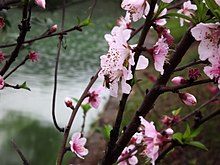
Prunus persica grows upward to 7 g (23 ft) tall and broad, merely when pruned properly, trees are usually three–4 m (10–xiii ft) tall and wide.[9] The leaves are lanceolate, 7–xvi cm (3–half-dozen+ one⁄2 in) long, ii–3 cm ( 3⁄4 –1+ 1⁄4 in) broad, and pinnately veined. The flowers are produced in early spring before the leaves; they are lonely or paired, 2.v–three cm diameter, pinkish, with 5 petals. The fruit has yellow or whitish mankind, a delicate aroma, and a pare that is either velvety (peaches) or polish (nectarines) in different cultivars. The flesh is very frail and hands bruised in some cultivars, merely is fairly firm in some commercial varieties, especially when green. The single, big seed is red-brown, oval shaped, around 1.3–two cm long, and surrounded by a wood-like husk. Peaches, along with cherries, plums, and apricots, are stone fruits (drupes). The diverse heirloom varieties including the 'Indian Peach', or 'Indian Blood Peach', which ripens in the latter part of the summer, and tin can have color ranging from red and white, to purple.[10]
Cultivated peaches are divided into clingstones and freestones, depending on whether the flesh sticks to the stone or not; both can take either white or yellow flesh. Peaches with white flesh typically are very sweet with footling acidity, while yellow-fleshed peaches typically have an acidic tang coupled with sweetness, though this besides varies greatly. Both colors often have some red on their skins. Low-acid, white-fleshed peaches are the most pop kinds in Communist china, Nihon, and neighbouring Asian countries, while Europeans and N Americans have historically favoured the acidic, xanthous-fleshed cultivars.
Etymology [edit]
The scientific proper name persica, along with the word "peach" itself – and its cognates in many European languages – derives from an early on European belief that peaches were native to Persia (mod-day Iran). The Aboriginal Romans referred to the peach every bit malum persicum ("Western farsi apple"), later becoming French pêche , whence the English "peach".[11] The scientific name, Prunus persica, literally means "Persian plum", as it is closely related to the plum.
Fossil record [edit]
Fossil endocarps with characteristics indistinguishable from those of modern peaches have been recovered from late Pliocene deposits in Kunming, dating to 2.6 million years ago. In the absence of bear witness that the plants were in other ways identical to the modern peach, the name Prunus kunmingensis has been assigned to these fossils.[12]
History [edit]
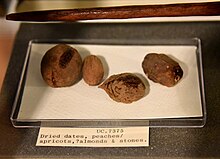
Although its botanical proper noun Prunus persica refers to Persia, genetic studies suggest peaches originated in Prc,[xiii] where they have been cultivated since the Neolithic menses. Until recently, cultivation was believed to have started around 2000 BC.[xiv] [15] More recent evidence indicates that domestication occurred as early as 6000 BC in Zhejiang Province of China. The oldest archaeological peach stones are from the Kuahuqiao site near Hangzhou. Archaeologists signal to the Yangtze River Valley as the identify where the early selection for favorable peach varieties probably took identify.[3] Peaches were mentioned in Chinese writings and literature first from the early offset millennium BC.[16]
A domesticated peach appeared very early in Japan, in 4700–4400 BC, during the Jōmon period. Information technology was already similar to modern cultivated forms, where the peach stones are significantly larger and more compressed than earlier stones. This domesticated blazon of peach was brought into Japan from Communist china. Nevertheless, in Mainland china itself, this variety is currently attested just at a later appointment effectually 3300 to 2300 BC.[17]
In India, the peach first appeared by about 1700 BC, during the Harappan period.[18]
It is also found elsewhere in Western Asia in ancient times.[19] Peach cultivation reached Hellenic republic by 300 BC.[15] Alexander the Great is sometimes said to take introduced them into Hellenic republic after conquering Persia,[19] only no historical evidence for this claim has been establish.[20] Peaches were, however, well known to the Romans in the beginning century Advertising;[15] the oldest known artistic representations of the fruit are in two fragments of wall paintings, dated to the first century AD, in Herculaneum, preserved due to the Vesuvius eruption of 79 AD, and now held in the National Archaeological Museum in Naples.[21] Archaeological finds prove that peaches were cultivated widely in Roman northwestern Continental Europe, but production collapsed effectually the sixth century; some revival of production followed with the Carolingian Renaissance of the 9th century.[22]
An article on peach tree tillage in Spain is brought downwardly in Ibn al-'Awwam's 12th-century agricultural piece of work, Volume on Agronomics.[23] The peach was brought to the Americas by Spanish explorers in the 16th century, and eventually made it to England and France in the 17th century, where it was a prized and expensive treat. Horticulturist George Minifie supposedly brought the starting time peaches from England to its North American colonies in the early 17th century, planting them at his estate of Buckland in Virginia.[24] Although Thomas Jefferson had peach trees at Monticello, American farmers did not begin commercial production until the 19th century in Maryland, Delaware, Georgia, South Carolina, and finally Virginia.[25]
The Shanghai dear nectar peach was a key component of both the nutrient culture and agrestal economy the area where the modernistic megacity of Shanghai stands. Peaches were the cornerstone of early Shanghai's garden civilisation. As modernization and westernization swept through the city the Shanghai dear nectar peach nearly disappeared completely. Much of modern Shanghai is built over these gardens and peach orchards.[26]
In April 2010, an international consortium, the International Peach Genome Initiative, which include researchers from the U.s.a., Italia, Chile, Kingdom of spain, and France, appear they had sequenced the peach tree genome (doubled haploid Lovell). Recently, it published the peach genome sequence and related analyses. The sequence is equanimous of 227 million nucleotides arranged in viii pseudomolecules representing the 8 peach chromosomes (2n = 16). In addition, 27,852 poly peptide-coding genes and 28,689 protein-coding transcripts were predicted.
Particular emphasis in this study is reserved for the assay of the genetic diversity in peach germplasm and how it was shaped past human activities such as domestication and breeding. Major historical bottlenecks were found, one related to the putative original domestication that is supposed to take taken place in China about 4,000–5,000 years ago, the second is related to the western germplasm and is due to the early dissemination of the peach in Europe from China and the more recent breeding activities in the United states and Europe. These bottlenecks highlighted the substantial reduction of genetic multifariousness associated with domestication and convenance activities.[27]
Cultivation [edit]
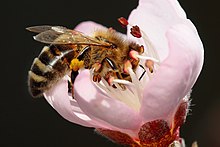
A peach flower with a bee pollinating information technology
Peaches grow in a fairly limited range in dry, continental or temperate climates, since the trees have a chilling requirement that tropical or subtropical areas generally do not satisfy except at high altitudes (for example in certain areas of Republic of ecuador, Colombia, Federal democratic republic of ethiopia, Bharat, and Nepal). Well-nigh cultivars require 500 hours of chilling around 0 to 10 °C (32 to 50 °F). During the chilling menstruum, cardinal chemical reactions occur, but the plant appears dormant. Once the spooky period is fulfilled, the plant enters a second type of dormancy, the quiescence period. During quiescence, buds break and grow when sufficient warm weather favorable to growth is accumulated.[28]
The trees themselves tin can usually tolerate temperatures to around −26 to −30 °C (−fifteen to −22 °F), although the post-obit season'due south flower buds are usually killed at these temperatures, preventing a crop that summer. Flower bud expiry begins to occur betwixt −15 and −25 °C (five and −13 °F), depending on the cultivar and on the timing of the cold, with the buds becoming less cold tolerant in tardily winter.[29]
Another climate constraint is leap frost. The trees flower fairly early (in March in Western Europe), and the blossom is damaged or killed if temperatures driblet below most −iv °C (25 °F). If the flowers are not fully open, though, they can tolerate a few degrees colder.[thirty]
Climates with significant winter rainfall at temperatures below xvi °C (61 °F) are also unsuitable for peach cultivation, equally the rain promotes peach foliage curl, which is the nearly serious fungal disease for peaches. In practise, fungicides are extensively used for peach cultivation in such climates, with more than 1% of European peaches exceeding legal pesticide limits in 2013.[31]
Finally, summer heat is required to mature the crop, with mean temperatures of the hottest calendar month betwixt 20 and 30 °C (68 and 86 °F).
Typical peach cultivars brainstorm bearing fruit in their tertiary year. Their lifespan in the U.S. varies by region; the University of California at Davis gives a lifespan of about 15 years[32] while the Academy of Maine gives a lifespan of 7 years there.[33]
Cultivars [edit]
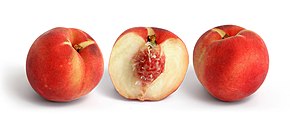
White peach of the clingstone variety
Hundreds of peach and nectarine cultivars are known. These are classified into two categories—freestones and clingstones. Freestones are those whose flesh separates readily from the pit. Clingstones are those whose flesh clings tightly to the pit. Some cultivars are partially freestone and clingstone, so are chosen semifree. Freestone types are preferred for eating fresh, while clingstone types are for canning. The fruit mankind may be creamy white to deep yellow, to dark carmine; the hue and shade of the color depend on the cultivar.[34]
Peach convenance has favored cultivars with more firmness, more red colour, and shorter fuzz on the fruit surface. These characteristics ease aircraft and supermarket sales past improving eye entreatment. This option procedure has non necessarily led to increased flavor, though. Peaches have a short shelf life, then commercial growers typically constitute a mix of dissimilar cultivars to accept fruit to ship all season long.[35]
Different countries have unlike cultivars. In the United Kingdom, for example, these cultivars take gained the Imperial Horticultural Gild's Award of Garden Merit:
- 'Knuckles of York'[36]
- 'Peregrine'[37]
- 'Rochester'[38]
- 'Lord Napier' (nectarine)[39]
Nectarines [edit]
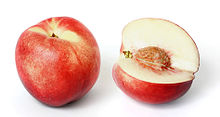
White nectarines, whole and cut open
The variety P. persica var. nucipersica (or var. nectarina), commonly called nectarine, has a smooth skin. Information technology is on occasion referred to as a "shaved peach" or "fuzzless peach", due to its lack of fuzz or brusk hairs. Though fuzzy peaches and nectarines are regarded commercially as different fruits, with nectarines often erroneously believed to be a crossbreed between peaches and plums, or a "peach with a plum skin", nectarines belong to the aforementioned species every bit peaches. Several genetic studies have concluded nectarines are produced due to a recessive allele, whereas a fuzzy peach skin is dominant.[half dozen] Nectarines have arisen many times from peach copse, oft equally bud sports.
As with peaches, nectarines can be white or yellowish, and clingstone or freestone. On boilerplate, nectarines are slightly smaller and sweeter than peaches, but with much overlap.[6] The lack of pare fuzz can make nectarine skins announced more cherry-red than those of peaches, contributing to the fruit's plum-like advent. The lack of down on nectarines' peel also means their skin is more easily bruised than peaches.
The history of the nectarine is unclear; the first recorded mention in English is from 1616,[40] but they had probably been grown much earlier inside the native range of the peach in fundamental and eastern asia. Although one source states that nectarines were introduced into the U.s.a. by David Fairchild of the Department of Agriculture in 1906,[41] a number of colonial-era newspaper articles make reference to nectarines being grown in the U.s.a. prior to the Revolutionary War. The 28 March 1768 edition of the New York Gazette (p. three), for instance, mentions a subcontract in Jamaica, Long Island, New York, where nectarines were grown.
Peacherines [edit]
Peacherines are claimed to be a cantankerous between a peach and a nectarine, just as they are the same species cannot be a truthful cross (hybrid); they are marketed in Australia and New Zealand. The fruit is intermediate in appearance, though, between a peach and a nectarine, big and brightly colored like a red peach. The flesh of the fruit is usually yellow, just white varieties as well exist. The Koanga Institute lists varieties that ripen in the Southern Hemisphere in February and March.[42] [43]
In 1909, Pacific Monthly mentioned peacherines in a news message for California. Louise Pound, in 1920, claimed the term peacherine is an example of linguistic communication stunt.[44]
Flat peaches [edit]
Flat peaches, or pan-tao, have a flattened shape, in contrast to ordinary almost-spherical peaches.[45]
Planting [edit]
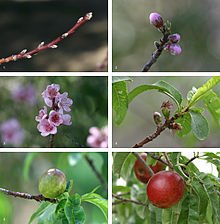
The developmental sequence of a nectarine over a
7+ 1⁄two -month period, from bud germination in early winter to fruit ripening in midsummer
Most peach trees sold by nurseries are cultivars budded or grafted onto a suitable rootstock. Common rootstocks are 'Lovell Peach', 'Nemaguard Peach', Prunus besseyi, and 'Commendation'.[46] The rootstock provides hardiness and budding is done to improve predictability of the fruit quality.
Peach copse demand total sun, and a layout that allows good natural air catamenia to help the thermal surround for the tree. Peaches are planted in early winter. During the growth flavor, they need a regular and reliable supply of water, with college amounts simply before harvest.[47]
Peaches need nitrogen-rich fertilizers more than other fruit trees. Without regular fertilizer supply, peach tree leaves showtime turning xanthous or showroom stunted growth. Blood repast, bone meal, and calcium ammonium nitrate are suitable fertilizers.
The flowers on a peach tree are typically thinned out because if the full number of peaches mature on a co-operative, they are undersized and lack flavour. Fruits are thinned midway in the season past commercial growers. Fresh peaches are easily bruised, so do not store well. They are most flavorful when they ripen on the tree and are eaten the day of harvest.[47]
The peach tree tin can be grown in an espalier shape. The Baldassari palmette is a design created around 1950 used primarily for grooming peaches. In walled gardens constructed from rock or brick, which absorb and retain solar heat and then slowly release it, raising the temperature against the wall, peaches can be grown as espaliers confronting south-facing walls as far north as southeast Not bad Britain and southern Ireland.
Insects [edit]
The starting time pest to attack the tree early on in the year when other food is scarce is the earwig (Forficula auricularia) which feeds on blossoms and young leaves at nighttime, preventing fruiting and weakening newly planted trees. The pattern of damage is distinct from that of caterpillars afterward in the year, as earwigs characteristically remove semicircles of petal and leaf tissue from the tips, rather than internally. Greasebands applied only before blossom are effective.[48] [ failed verification ]
The larvae of such moth species equally the peachtree borer (Synanthedon exitiosa), the yellow peach moth (Conogethes punctiferalis), the well-marked cutworm (Abagrotis orbis), Lyonetia prunifoliella, Phyllonorycter hostis, the fruit tree borer (Maroga melanostigma), Parornix anguliferella, Parornix finitimella, Caloptilia zachrysa, Phyllonorycter crataegella, Trifurcula sinica, Suzuki's promolactis moth (Promalactis suzukiella), the white-spotted tussock moth (Orgyia thyellina), the apple tree leafroller (Archips termias), the catapult moth (Serrodes partita), the wood groundling (Parachronistis albiceps) or the omnivorous leafroller (Platynota stultana) are reported to feed on P. persica. The flatid planthopper (Metcalfa pruinosa) causes harm to fruit copse.
The tree is also a host plant for such species as the Japanese beetle (Popillia japonica), the unmonsuzume (Callambulyx tatarinovii), the promethea silkmoth (Callosamia promethea), the orangish oakleaf (Kallima inachus), Langia zenzeroides, the speckled emperor (Gynanisa maja) or the brown playboy (Deudorix antalus). The European ruby mite (Panonychus ulmi) or the yellow mite (Lorryia formosa) are also found on the peach tree.
It is a adept pollen source for honey bees and a honeydew source for aphids.
Diseases [edit]
Peach copse are decumbent to a disease called leaf curl, which usually does not directly affect the fruit, but does reduce the crop yield by partially defoliating the tree. Several fungicides can exist used to combat the affliction, including Bordeaux mixture and other copper-based products (the University of California considers these organic treatments), ziram, chlorothalonil, and dodine.[49] The fruit is susceptible to brown rot or a dark reddish spot.
Storage [edit]
Peaches and nectarines are best stored at temperatures of 0 °C (32 °F) and in high humidity.[34] They are highly perishable, and then are typically consumed or canned inside two weeks of harvest.
Peaches are climacteric[50] [51] [52] fruits and continue to ripen after existence picked from the tree.[53]
Production [edit]
| Peach (and nectarine) production, 2018 | ||
|---|---|---|
| Land | Production (millions of tonnes) | |
 People's republic of china People's republic of china | 15.nineteen | |
 Italian republic Italian republic | 1.09 | |
 Greece Greece | 0.96 | |
 Kingdom of spain Kingdom of spain | 0.90 | |
 Turkey Turkey | 0.78 | |
 United states of america United states of america | 0.70 | |
 Iran Iran | 0.64 | |
 Chile Chile | 0.31 | |
 Bharat Bharat | 0.27 | |
 Egypt Egypt | 0.24 | |
| Globe | 24.45 | |
| Source: United Nations, FAOSTAT [8] | ||
In 2018, world production of peaches (combined with nectarines for reporting) was 24.v million tonnes, led by Prc with 62% of the world full (table).
The U.South. country of Georgia is known as the "Peach State" due to its significant production of peaches equally early equally 1571,[54] with exports to other states occurring around 1858.[55] In 2014, Georgia was third in US peach production behind California and Southward Carolina.[54]
Cultural significance [edit]
Peaches are not only a popular fruit, but too are symbolic in many cultural traditions, such equally in art, paintings, and folk tales such as Peaches of Immortality.
China [edit]
Peach blossoms are highly prized in Chinese culture. The aboriginal Chinese believed the peach to possess more vitality than whatsoever other tree considering their blossoms announced before leaves sprout. When early rulers of China visited their territories, they were preceded by sorcerers armed with peach rods to protect them from spectral evils. On New Twelvemonth'south Eve, local magistrates would cut peach wood branches and place them over their doors to protect confronting evil influences.[56] Peach wood was too used for the primeval known door gods during the Han. Some other author writes:
The Chinese besides considered peach wood (t'ao-fu) protective against evil spirits, who held the peach in awe. In ancient China, peach-wood bows were used to shoot arrows in every management in an effort to dispel evil. Peach-forest slips or carved pits served as amulets to protect a person'south life, prophylactic, and health.[57]
Peachwood seals or figurines guarded gates and doors, and, as one Han account recites, "the buildings in the capital are fabricated tranquil and pure; everywhere a good state of affairs prevails".[57] Writes the author, further:
Another aid in fighting evil spirits were peach-wood wands. The Li-chi (Han period) reported that the emperor went to the funeral of a government minister escorted by a sorcerer carrying a peachwood wand to keep bad influences away. Since that fourth dimension, peachwood wands take remained an important means of exorcism in People's republic of china.[57]
Peach kernels (桃仁 táo rén) are a mutual ingredient used in traditional Chinese medicine to dispel claret stasis, counter inflammation, and reduce allergies.[58]
In an orchard of flowering peach trees, Liu Bei, Guan Yu, and Zhang Fei took an oath of brotherhood in the opening chapter of the classic Chinese novel Romance of the Three Kingdoms. Some other peach orchard, in "The Peach Blossom Spring" by poet Tao Yuanming, is the setting of the favourite Chinese fable and a metaphor for utopias. A peach tree growing on a precipice was where the Taoist master Zhang Daoling tested his disciples.[59]
The Sometime Human being of the South Pole, ane of the deities of the Chinese folk religion fulu shou, is sometimes seen holding a large peach, representing long life and wellness.[ citation needed ]
The term "bitten peach", first used by Legalist philosopher Han Fei in his work Han Feizi, became a byword for homosexuality. The book records the incident when courtier Mizi Xia bit into an especially delicious peach and gave the remainder to his lover, Duke Ling of Wei, equally a gift so that he could taste information technology, as well.[ commendation needed ]
Korea [edit]
In Korea, peaches take been cultivated from ancient times. According to Samguk Sagi, peach trees were planted during the Three Kingdoms of Korea period, and Sallim gyeongje also mentions cultivation skills of peach copse. The peach is seen as the fruit of happiness, riches, honours, and longevity. The rare peach with double seeds is seen every bit a favorable omen of a balmy winter. Information technology is one of the 10 immortal plants and animals, so peaches appear in many minhwa (folk paintings). Peaches and peach trees are believed to chase away spirits, and then peaches are not placed on tables for jesa (ancestor veneration), unlike other fruits.[60] [61]
Nihon [edit]
The world'due south sweetest peach is grown in Fukushima, Japan. The Guinness earth record for the sweetest peach is currently held by a peach grown in Kanechika, Japan, with a saccharide content of 22.ii%. Withal, a fruit farm in rural Fukushima, Koji grew a much sweeter peach, with a Brix score of 32°. Degrees Brix measures the sugar content of the fruit, and is usually between 11 and 15 for a typical peach from a supermarket.[62]
Vietnam [edit]
A Vietnamese mythic history states that in the spring of 1789, after marching to Ngọc Hồi and so winning a great victory against invaders from the Qing dynasty of Mainland china, Emperor Quang Trung ordered a messenger to gallop to Phú Xuân citadel (now Huế) and deliver a flowering peach co-operative to the Princess Ngọc Hân. This took place on the 5th solar day of the first lunar month, 2 days before the predicted finish of the boxing. The branch of peach flowers that was sent from the north to the centre of Vietnam was not merely a message of victory from the King to his wife, but too the showtime of a new spring of peace and happiness for all the Vietnamese people. In improver, since the country of Nhật Tân had freely given that very branch of peach flowers to the King, information technology became the loyal garden of his dynasty.
The protagonists of The Tale of Kieu barbarous in love by a peach tree, and in Vietnam, the blossoming peach blossom is the signal of bound. Finally, peach bonsai trees are used as decoration during Vietnamese New year (Tết) in northern Vietnam.[ citation needed ]
Europe [edit]
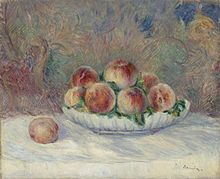
Many famous artists have painted with peach fruits placed in prominence. Caravaggio, Vicenzo Campi, Pierre-Auguste Renoir, Claude Monet, Édouard Manet, Henri Fantin-Latour, Severin Roesen, Peter Paul Rubens, and Van Gogh are amongst the many influential artists who painted peaches and peach trees in diverse settings.[63] [64] Scholars suggest that many compositions are symbolic, some an effort to introduce realism.[65] For example, Tresidder claims[66] the artists of Renaissance symbolically used peach to represent eye, and a leaf fastened to the fruit as the symbol for tongue, thereby implying speaking truth from 1'south eye; a ripe peach was also a symbol to imply a ripe country of good wellness. Caravaggio paintings introduce realism past painting peach leaves that are molted, discolored, or in some cases have wormholes – weather mutual in modernistic peach cultivation.[64]
U.s.a. [edit]
Due south Carolina named the peach its official fruit in 1984.[67] The peach became the state fruit of Georgia, nicknamed the "Peach Country", in 1995.[68] The peach went from feral trees utilized opportunistically to a tended commercial crop in the Southern United States in the 1850s, as the boll weevil attacked regional cotton wool crops. When Georgia reached peak production in the 1920s, elaborate festivals celebrated the fruit. By 2017, Georgia's production represented three–5% of the U.South. total.[69] [70] Alabama named it the "state tree fruit" in 2006.[71] Delaware's state flower has been the peach blossom since 1995,[72] and peach pie became its official dessert in 2009.[73]
Nutrition [edit]
| Nutritional value per 100 g (three.5 oz) | |
|---|---|
| Energy | 165 kJ (39 kcal) |
| Carbohydrates | 9.54 g |
| Sugars | 8.39 grand |
| Dietary cobweb | ane.5 g |
| Fat | 0.25 g |
| Protein | 0.91 g |
| Vitamins | Quantity %DV † |
| Vitamin A equiv. beta-Carotene | ii% xvi μg2% 162 μg |
| Thiamine (B1) | two% 0.024 mg |
| Riboflavin (B2) | 3% 0.031 mg |
| Niacin (Bthree) | 5% 0.806 mg |
| Pantothenic acid (Bv) | three% 0.153 mg |
| Vitamin B6 | 2% 0.025 mg |
| Folate (B9) | 1% 4 μg |
| Choline | one% 6.1 mg |
| Vitamin C | viii% 6.6 mg |
| Vitamin East | 5% 0.73 mg |
| Vitamin Chiliad | 2% 2.6 μg |
| Minerals | Quantity %DV † |
| Calcium | 1% six mg |
| Iron | 2% 0.25 mg |
| Magnesium | iii% 9 mg |
| Manganese | 3% 0.061 mg |
| Phosphorus | three% twenty mg |
| Potassium | iv% 190 mg |
| Sodium | 0% 0 mg |
| Zinc | ii% 0.17 mg |
| Other constituents | Quantity |
| Water | 89 g |
| Link to USDA Database entry | |
| |
| †Percentages are roughly approximated using United states of america recommendations for adults. Source: USDA FoodData Central | |
Raw peach flesh is 89% h2o, x% carbohydrates, ane% protein, and contains negligible fatty. A medium sized raw peach, weighing 100 g (3.5 oz), supplies 39 calories, and contains small amounts of essential nutrients, merely none is a significant proportion of the Daily Value (DV, right tabular array). A raw nectarine has like depression content of nutrients.[74] The glycemic load of an average peach (120 grams) is 5, similar to other low-sugar fruits.[75]
Phytochemicals [edit]
Full polyphenols in mg per 100 g of fresh weight were 14–102 in white-mankind nectarines, 18–54 in yellow-mankind nectarines, 28–111 in white-flesh peaches, and 21–61 mg per 100 chiliad in yellow-flesh peaches.[76] The major phenolic compounds identified in peach are chlorogenic acid, catechins and epicatechins,[77] with other compounds, identified by HPLC, including gallic acid and ellagic acid.[78] Rutin and isoquercetin are the primary flavonols found in clingstone peaches.[79]
Carmine-fleshed peaches are rich in anthocyanins,[80] specially cyanidin glucosides in vi peach and six nectarine cultivars[81] and malvin glycosides in clingstone peaches.[79] As with many other members of the rose family, peach seeds contain cyanogenic glycosides, including amygdalin (note the subgenus designation: Amygdalus).[82] These substances are capable of decomposing into a sugar molecule and hydrogen cyanide gas.[83] [82] Cyanogenic glycosides are toxic if consumed in big doses.[84] While peach seeds are not the most toxic within the rose family (come across bitter almond), large consumption of these chemicals from whatsoever source is potentially hazardous to animal and human wellness.[83]
Peach allergy or intolerance is a relatively mutual form of hypersensitivity to proteins contained in peaches and related fruits (such as almonds). Symptoms range from local effects (due east.m. oral allergy syndrome, contact urticaria) to more severe systemic reactions, including anaphylaxis (e.k. urticaria, angioedema, gastrointestinal and respiratory symptoms).[85] Adverse reactions are related to the "freshness" of the fruit: peeled or canned fruit may be tolerated.
Aroma [edit]
Some 110 chemic compounds contribute to peach odour, including alcohols, ketones, aldehydes, esters, polyphenols and terpenoids.[86]
Gallery [edit]
-
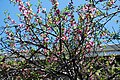
A peach tree in flower
-
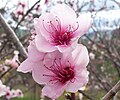
Peach blossoms
-
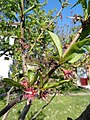
Incipient fruit development
-
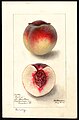
Peach (cultivar 'Berry') – watercolour, 1895
-

-

Prunus persica - MHNT
References [edit]
- ^ "IPNI Plant name Query Results". ipni.org. Archived from the original on 25 September 2015.
- ^ The Found List, Prunus persica (Fifty.) Batsch
- ^ a b Yang, Xiaoyan; Zheng, Yunfei; Crawford, Gary W.; Chen, Xugao (2014). "Archaeological Evidence for Peach (Prunus persica) Cultivation and Domestication in Prc". PLOS ONE. ix (9): e106595. Bibcode:2014PLoSO...9j6595Z. doi:10.1371/journal.pone.0106595. ISSN 1932-6203. PMC4156326. PMID 25192436.
- ^ "Almond Tree - Learn About Nature". 27 July 2016. Retrieved 8 April 2022.
- ^ Haase, Ilka; Brüning, Philipp; Matissek, Reinhard; Fischer, Markus (ten April 2013). "Existent-time PCR assays for the quantitation of rDNA from apricot and other plant species in marzipan". Journal of Agricultural and Food Chemical science. 61 (xiv): 3414–3418. doi:ten.1021/jf3052175. ISSN 1520-5118. PMID 23495652.
- ^ a b c "Frequently Asked Questions". Oregon State Academy. Archived from the original on 14 July 2008.
- ^ Vendramin, Elisa; Pea, Giorgio; Dondini, Luca; Pacheco, Igor; Dettori, Maria Teresa; Gazza, Laura; Scalabrin, Simone; Strozzi, Francesco; Tartarini, Stefano (3 March 2014). "A Unique Mutation in a MYB Gene Cosegregates with the Nectarine Phenotype in Peach". PLOS I. 9 (iii): e90574. Bibcode:2014PLoSO...990574V. doi:x.1371/journal.pone.0090574. ISSN 1932-6203. PMC3940905. PMID 24595269.
- ^ a b "Production of peaches and nectarines in 2018; Crops/Regions/World/Production Quantity (from pick lists)". United Nations, Food and Agricultural System, Statistics Division (FAOSTAT). 2019. Retrieved eleven April 2020.
- ^ "The Average Width of a Peach Tree". SFGate. Hearst Communications Inc. Retrieved 23 October 2018.
- ^ "Indian Peaches Information, Recipes and Facts". Specialtyproduce.com. Archived from the original on 20 September 2012. Retrieved 24 September 2012.
- ^ Campbell, Lyle (2004) Historical Linguistics: An Introduction, 2nd ed., Cambridge, Massachusetts: MIT Press, p. 274. ISBN 0-262-53267-0.
- ^ Su, T.; et al. (2016). "Peaches Preceded Humans: Fossil Bear witness from SW Red china". Scientific Reports. Nature Publishing Grouping. 5: 16794. Bibcode:2015NatSR...516794S. doi:10.1038/srep16794. PMC4660870. PMID 26610240.
- ^ Thacker, Christopher (1985). The history of gardens . Berkeley: Academy of California Press. p. 57. ISBN978-0-520-05629-9.
- ^ Singh, Akath; Patel, R.K.; Babu, K.D.; De, L.C. (2007). "Low chiling peaches". Underutilized and underexploited horticultural crops. New Delhi: New India Publishing. p. 90. ISBN978-81-89422-69-ane.
- ^ a b c Geissler, Catherine (2009). The New Oxford Volume of Food Plants . Oxford: Oxford University Press. p. 82. ISBN978-0-19-160949-vii.
- ^ Layne, Desmond R.; Bassi, Daniele (2008). The Peach: Botany, Product and Uses. CAB International. ISBN978-1-84593-386-9.
- ^ Yang, Xiaoyan; Zheng, Yunfei; Crawford, Gary Due west.; Chen, Xugao (2014). "Archaeological Evidence for Peach (Prunus persica) Cultivation and Domestication in China". PLOS ONE. nine (nine): e106595. Bibcode:2014PLoSO...9j6595Z. doi:10.1371/journal.pone.0106595. ISSN 1932-6203. PMC4156326. PMID 25192436.
- ^ Fuller, D; Madella, G (2001). "Problems in Harappan Archaeobotany: Retrospect and Prospect". In Settar, S; Korisettar, R (eds.). Indian Archeology in Hindsight. Vol. II. Protohistory. New Delhi: Manohar. pp. 317–390.
- ^ a b Ensminger, Audrey H. (1994). Foods & nutrition encyclopedia. CRC Press. ISBN0-8493-8980-i.
- ^ Davidson, Alan (1999). The Oxford Companion to Nutrient (ane ed.). Oxford: Oxford Academy Press. p. 588. ISBN0-xix-211579-0.
- ^ Sadori, Laura; et al. (2009). "The introduction and diffusion of peach in ancient Italy" (PDF). Edipuglia. Archived (PDF) from the original on 14 January 2013.
- ^ Noah Blan, 'Charlemagne's Peaches: A Example of Early Medieval European Ecological Accommodation', Early on Medieval Europe, 27.4 (2019), 521–45.
- ^ Ibn al-'Awwam, Yaḥyá (1864). Le livre de l'agriculture d'Ibn-al-Awam (kitab-al-felahah) (in French). Translated by J.-J. Clement-Mullet. Paris: A. Franck. pp. 315–319 (ch. 7 – Article 41). OCLC 780050566. (pp. 315–319 (Commodity XLI)
- ^ "George Minifie". Genforum.genealogy.com. 21 March 1999. Archived from the original on 14 January 2013. Retrieved 24 September 2012.
- ^ Fogle, H. West. (1965). Peach Product Due east of the Rocky Mountains. Agricultural Research Service, U.S. Department of Agronomics. p. i.
- ^ Swislocki, Mark (2009). Culinary Nostalgia. Stanford, California: Stanford University Press. pp. 29–64. ISBN978-0-8047-6012-6.
- ^ Verde, I.; Abbott, A.Thousand.; Scalabrin, S.; Jung, Southward.; et al. (2013). "The high-quality typhoon genome of peach (Prunus persica) identifies unique patterns of genetic variety, domestication and genome evolution". Nature Genetics. 45 (5): 487–494. doi:10.1038/ng.2586. hdl:2434/218547. PMID 23525075.
- ^ "Peach tree physiology" (PDF). Academy of Georgia. 2007. Archived from the original (PDF) on 10 June 2010.
- ^ Szalay, L.; Papp, J.; Szaóbo, Z. (2000). "Evaluation of frost tolerance of peach varieties in artificial freezing tests". Acta Horticulturae. 538 (538): 407–410. doi:10.17660/ActaHortic.2000.538.71.
- ^ Chunxian Chen, William R. Okie, Thomas K. Beckman (July 2016). "Peach Fruit Set and Buttoning after Spring Frost". American Lodge for Horticultural Science. 51: Upshot 7 (7): 816–821. doi:10.21273/HORTSCI.51.vii.816.
{{cite periodical}}: CS1 maint: multiple names: authors list (link) - ^ European Nutrient Condom Authority (2015). "The 2013 European Matrimony report on pesticide residues in food". EFSA Journal. thirteen (3): 4038. doi:10.2903/j.efsa.2015.4038. Archived from the original on 15 March 2015.
The highest maximum rest level (MRL) exceedance charge per unit was found for strawberries (ii.five% of the samples), followed by lettuce (2.3%), oats (1.3%), peaches (1.1%), and apples (1.0%).
- ^ "Fruit and Nut Varieties for Depression-Tiptop Sierra Foothills" (PDF). University of California at Davis. Nov 2009. Archived (PDF) from the original on 12 June 2010. Retrieved 25 August 2015.
- ^ "Growing Peaches in Maine". Archived from the original on 26 August 2015. Retrieved 25 Baronial 2015.
- ^ a b "Peach and Nectarine Culture". Academy of Rhode Island. 2000. Archived from the original on xiv January 2013.
- ^ Okie, West.R. (2005). "Varieties – Peaches" (PDF). The states Department of Agronomics. Archived from the original (PDF) on fourteen January 2013.
- ^ "RHS Plant Selector Prunus persica 'Duke of York' (F) AGM / RHS Gardening". Apps.rhs.org.uk. Archived from the original on xiv January 2013. Retrieved 24 September 2012.
- ^ "RHS Plant Selector Prunus persica 'Peregrine' (F) AGM / RHS Gardening". Apps.rhs.org.uk. Archived from the original on 14 January 2013. Retrieved 24 September 2012.
- ^ "RHS Institute Selector Prunus persica 'Rochester' (F) AGM / RHS Gardening". Apps.rhs.org.uk. Archived from the original on 14 January 2013. Retrieved 24 September 2012.
- ^ "RHS Plant Selector Prunus persica var. nectarina 'Lord Napier' (F) AGM / RHS Gardening". Apps.rhs.org.uk. Archived from the original on xiv January 2013. Retrieved 24 September 2012.
- ^ Oxford English Dictionary
- ^ Fairchild, David (1938). The World Was My Garden . New York: Charles Scribner'southward Sons. p. 226.
- ^ "Almonds, Nectarines, Peacherines and Apricots". Koanga Establish. Archived from the original on 15 February 2014. Retrieved 8 Jan 2014.
- ^ Shimabukuro, Betty (7 July 2004). "Mixed marriages: Cross-pollination produces fruit "children" that aren't quite the same every bit mom and dad". Honolulu Star-Message. Archived from the original on 2 March 2012. Retrieved 8 January 2014.
- ^ Pound, Louise (1920). "Stunts in language". The English Language. 9 (2): 88–95. doi:10.2307/802441. JSTOR 802441.
- ^ Layne, Desmond (2008). The Peach: Phytology, Production and uses. CABI. p. 16. ISBN978-i-84593-386-9 . Retrieved 3 August 2015.
- ^ Ingels, Chuck; et al. (2007). The Home Orchard: Growing Your Own Deciduous Fruit and Nut Trees. University of California Agronomics and Natural Resources. pp. 29–thirty.
- ^ a b McCraw, Dean. "Planting and Early Care of the Peach Orchard". Oklahoma Cooperative Extension Service. Archived (PDF) from the original on xvi September 2012.
- ^ "Wer frisst Pfirsich-Blütenknopsen?" [Who eats peach blossom buds?]. Garten-pur.de (in German). ix April 2010. Archived from the original on two January 2014. Retrieved 1 January 2014.
- ^ "UC Pest Management Guidelines". UC Davis. 10 September 2015. Archived from the original on 19 Jan 2016. Retrieved 3 November 2015.
- ^ Trainotti, Fifty.; Tadiello, A.; Casadoro, 1000. (2007). "The interest of auxin in the ripening of climacteric fruits comes of historic period: The hormone plays a function of its own and has an intense coaction with ethylene in ripening peaches". Journal of Experimental Botany. 58 (12): 3299–3308. doi:x.1093/jxb/erm178. PMID 17925301.
- ^ Ziosi, V.; Bregoli, A. M.; Fiori, G.; Noferini, M.; Costa, Yard. (2007). "1-MCP furnishings on ethylene emission and fruit quality traits of peaches and nectarines". Advances in Plant Ethylene Research. p. 167. doi:10.1007/978-1-4020-6014-4_38. ISBN978-1-4020-6013-7. S2CID 81245874.
- ^ "Prunus persica, peach, nectarine". GeoChemBio.com. Archived from the original on 25 July 2012. Retrieved 24 September 2012.
- ^ "Healthy and Sustainable Nutrient". The Eye for Health and the Global Environment. Harvard Medical School. xvi Nov 2011. Archived from the original on xi February 2012. Retrieved 24 September 2012.
- ^ a b Kathryn C. Taylor (15 Baronial 2003). "Peaches". New Georgia Encyclopedia. Georgia Humanities Council and the University of Georgia Printing. Archived from the original on 5 July 2015. Retrieved 3 August 2015.
- ^ Fair, John D. (2002). "The Georgia Peach and the Southern Quest for Commercial Disinterestedness and Independence, 1843–1861". Georgia Historical Quarterly. 86 (3): 372. Retrieved 19 February 2018.
- ^ Doré S.J., Henry; Kennelly, S. J. (translator), M. (1914). Researches into Chinese Superstitions. Vol. Five. Tusewei Press, Shanghai. p. 505.
- ^ a b c Simoons, Frederick J. (1991) Food in China: A Cultural and Historical Enquiry, p. 218, ISBN 0-8493-8804-X.
- ^ "TCM: Peach kernels" (in Chinese). Archived from the original on 16 July 2011. Retrieved 1 November 2010.
- ^ Eskildsen, Stephen (1998). Asceticism in early on taoist religion. SUNY Printing. p. 26. ISBN978-0-7914-3955-5. Archived from the original on 16 May 2016.
- ^ 한국에서의 복숭아 재배 [Peach cultivation in Korea] (in Korean). Nate / Britannica. Archived from the original on 24 May 2012. Retrieved 12 January 2010.
- ^ 복숭아 [Peach] (in Korean). Nate / Encyclopedia of Korean Culture. Archived from the original on 24 May 2012. Retrieved 12 January 2010.
- ^ "The world's sweetest peach costs $7,000. So is information technology worth the price tag?". www.abc.net.au. 17 July 2020. Retrieved 18 July 2020.
- ^ Torpy, Janet M. (2010). "Withal Life With Peaches". JAMA. 303 (iii): 203. doi:x.1001/jama.2009.1853. PMID 20085943.
- ^ a b Jules Janick. "Caravaggio's Fruit: A Mirror on Baroque Horticulture" (PDF). Archived from the original (PDF) on 14 January 2013. Retrieved 24 September 2012.
- ^ de Groft; Aaron H. (2006). "Caravaggio – Still Life with Fruit on a Stone Ledge" (PDF). Papers of the Muscarelle Museum of Art, Book 1. Archived from the original (PDF) on 14 Jan 2013.
- ^ Tresidder, Jack (2004). i,001 Symbols: An Illustrated Guide to Imagery and Its Pregnant. ISBN978-0-8118-4282-2.
- ^ Plants & Edibles, South Carolina Legislature Online, retrieved 29 May 2019
- ^ "State Fruit". Georgia State Symbols. Georgia Secretary of Land. Retrieved 29 May 2019.
- ^ Okie, William Thomas (14 August 2017), "The Fuzzy History of the Georgia Peach", Smithsonian.com , retrieved 29 May 2019
- ^ Mackie, Matt (1 November 2018), "Is Georgia actually the Peach State?", wxga.com , retrieved 29 May 2019
- ^ "State Tree Fruit of Alabama". Alabama Emblems, Symbols and Honors. Alabama Department of Archives and History. xx April 2006. Retrieved 29 May 2019.
- ^ "Delaware State Plants". Delaware.gov . Retrieved 30 May 2019.
- ^ "Delaware Miscellaneous Symbols". Delaware.gov . Retrieved 29 May 2019.
- ^ "Diet Facts for Nectarines, raw, per 100 g". Conde Nast, USDA National Nutrient Database, version SR-21. 2014. Archived from the original on 15 March 2015. Retrieved fourteen March 2015.
- ^ "Glycemic index and glycemic load for 100+ foods". Harvard Wellness Publications, Harvard Academy School of Medicine. 27 August 2015. Archived from the original on 25 April 2017. Retrieved 26 Apr 2017.
- ^ Gil, 1000. I.; Tomás-Barberán, F. A.; Hess-Pierce, B.; Kader, A. A. (2002). "Antioxidant capacities, phenolic compounds, carotenoids, and vitamin C contents of nectarine, peach, and plum cultivars from California". Journal of Agricultural and Food Chemistry. 50 (17): 4976–4982. doi:x.1021/jf020136b. PMID 12166993.
- ^ Cheng, Guiwen Westward. & Crisosto, Carlos H. (1995). "Browning Potential, Phenolic Composition, and Polyphenoloxidase Activity of Buffer Extracts of Peach and Nectarine Peel Tissue". J. Am. Soc. Hort. Sci. 120 (five): 835–838. doi:ten.21273/JASHS.120.v.835.
- ^ Infante, Rodrigo; Contador, Loreto; Rubio, Pía; Aros, Danilo & Peña-Neira, Álvaro (2011). "Postharvest sensory and phenolic label of 'Elegant Lady' and 'Carson' peaches" (PDF). Chilean Journal of Agricultural Research. 71 (3): 445–451. doi:10.4067/S0718-58392011000300016. Archived (PDF) from the original on xi July 2012.
- ^ a b Chang, South; Tan, C; Frankel, EN; Barrett, DM (2000). "Low-density lipoprotein antioxidant activeness of phenolic compounds and polyphenol oxidase activity in selected clingstone peach cultivars". Journal of Agronomical and Food Chemistry. 48 (2): 147–51. doi:10.1021/jf9904564. PMID 10691607.
- ^ Cevallos-Casals, B. V. A.; Byrne, D.; Okie, Westward. R.; Cisneros-Zevallos, L. (2006). "Selecting new peach and plum genotypes rich in phenolic compounds and enhanced functional properties". Nutrient Chemistry. 96 (2): 273–280. doi:10.1016/j.foodchem.2005.02.032.
- ^ Andreotti, C.; Ravaglia, D.; Ragaini, A.; Costa, Yard. (2008). "Phenolic compounds in peach (Prunus persica) cultivars at harvest and during fruit maturation". Annals of Applied Biology. 153: eleven–23. doi:10.1111/j.1744-7348.2008.00234.x.
- ^ a b Lee, SH; Oh, A; Shin, SH; Kim, HN; Kang, WW; Chung, SK (2017). "Amygdalin contents in peaches at different fruit development stages". Preventive Nutrition and Food Science. 22 (3): 237–240. doi:10.3746/pnf.2017.22.3.237. ISSN 2287-1098. PMC5642807. PMID 29043223.
- ^ a b Cho HJ, Do BK, Shim SM, Kwon H, Lee DH, Nah AH, Choi YJ, Lee SY (2013). "Determination of cyanogenic compounds in edible plants by ion chromatography". Toxicol Res. 29 (ii): 143–vii. doi:10.5487/TR.2013.29.ii.143. PMC3834451. PMID 24278641.
{{cite journal}}: CS1 maint: uses authors parameter (link) - ^ "Laetrile (Amygdalin)". US National Cancer Institute. 25 October 2019. Retrieved 3 September 2020.
- ^ Besler, M.; Cuesta Herranz, Javier & Fernandez-Rivas, Montserrat (2000). "Allergen Data Collection: Peach (Prunus persica)". Net Symposium on Nutrient Allergens. 2 (4): 185–201. Archived from the original on 17 August 2009.
- ^ Sánchez M, Besada C, Badenes ML, Monforte AJ, Granell A (2012). "A non-targeted approach unravels the volatile network in peach fruit". PLOS ONE. 7 (6): e38992. Bibcode:2012PLoSO...738992S. doi:10.1371/periodical.pone.0038992. PMC3382205. PMID 22761719.
{{cite journal}}: CS1 maint: uses authors parameter (link)
Further reading [edit]
- Okie, William Thomas. The Georgia Peach: Civilization, Agronomics, and Environment in the American South (Cambridge Studies on the American South, 2016).
External links [edit]
- "Prunus persica". Plants for a Time to come.
- National Centre for Abode Food Preservation—Freezing Peaches
- Bioimages.vanderbilt.edu – Prunus persica images
- Clemson.edu: Everything Nearly Peaches
Source: https://en.wikipedia.org/wiki/Peach
0 Response to "Peach & Lily Cold Brew Eye Recovery Stick Reviews"
Publicar un comentario